A bright, confident smile is more than just a cosmetic feature; it’s a powerful tool for communication and self-assurance. Yet, daily life, with its love for coffee, tea, and red wine, can leave our teeth looking less than their brilliant best. Discolouration and staining are common concerns, but the path to a whiter smile is often confusing. With so many options available, from professional treatments to over-the-counter products, it’s difficult to know which method is right for you, your budget, and your specific type of staining.
This guide is designed to cut through that confusion. We will provide a clear, detailed breakdown of the best teeth whitening methods available today. Whether you are considering a dramatic change with a professional smile makeover or simply looking for ways to brighten your smile at home, this article will equip you with the knowledge to make an informed decision. We’ll explore everything from powerful in-clinic procedures to the effectiveness of whitening toothpastes and even natural alternatives.
For each method, we will cover crucial details, including:
- How it works: The science behind the sparkle.
- Effectiveness and timeline: What results you can realistically expect and how quickly.
- Safety and side effects: Understanding the potential risks, like sensitivity.
- Ideal candidacy: Which stains each method targets best.
- Cost considerations: A look at the typical investment.
For patients considering treatment abroad, particularly at our clinic in Turkey, we’ll also highlight how you can achieve your dream smile while enjoying significant savings. Get ready to discover the perfect route to unlocking your brightest, most dazzling smile.
1. Professional In-Office Teeth Whitening (Dental Clinic Treatment)
For those seeking the most dramatic and immediate results, professional in-office whitening performed at a dental clinic is the gold standard. This method involves a qualified dentist applying a high-concentration peroxide gel (typically 15-35% hydrogen peroxide) directly to your teeth. The powerful bleaching agent is often activated by a special LED or laser light, which accelerates the whitening process and breaks down stubborn stains deep within the enamel.
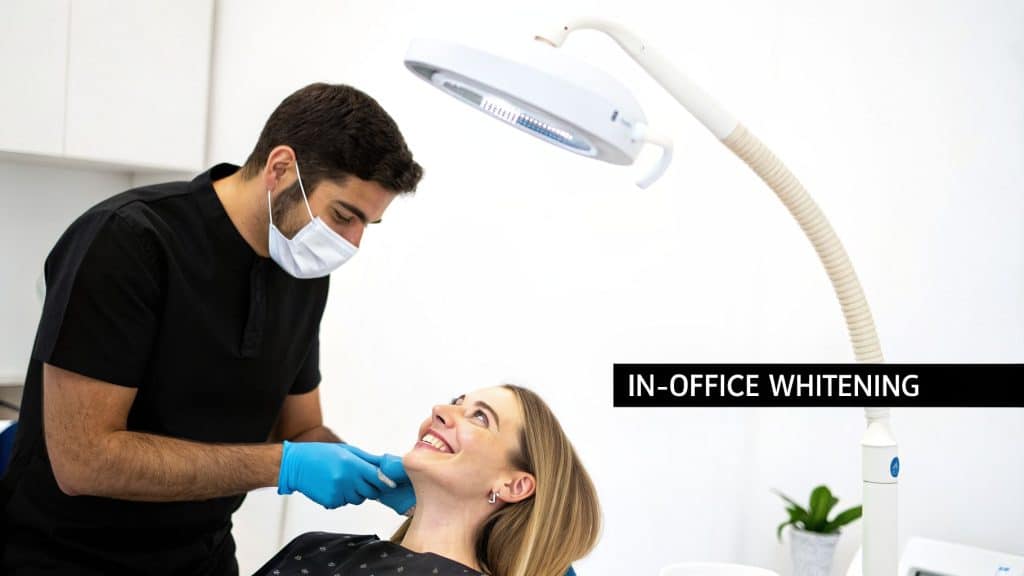
Unlike over-the-counter options that take weeks to show modest changes, a single 60-90 minute appointment can lighten your teeth by several shades. This makes it one of the best teeth whitening methods for time-sensitive events.
Who Is It For?
This treatment is ideal for individuals with deep-set, intrinsic stains caused by ageing, coffee, red wine, or tobacco. It is also a critical first step in a larger smile makeover. For instance, patients at Centre Dental Clinic often undergo whitening before receiving crowns or veneers to ensure the new restorations are matched to a brighter, more youthful smile. Business professionals from the UK frequently choose this option for a rapid confidence boost before important presentations.
What to Expect and Key Tips
Your dentist will first protect your gums and lips with a barrier before carefully applying the whitening gel. The procedure is monitored from start to finish to ensure safety and effectiveness.
- Pre-Treatment: For optimal results, combine your whitening session with a professional cleaning to remove plaque and surface debris.
- Post-Treatment: Avoid staining foods and drinks like coffee, tea, and berries for at least 48 hours as your teeth are more porous and susceptible to re-staining.
- Sensitivity Management: Some temporary sensitivity is normal. Using a fluoride toothpaste can help manage any discomfort.
- Cosmetic Work: Schedule your whitening at least two weeks before any crown or veneer placements. This allows the shade to stabilise for a perfect colour match.
- Maintenance: Ask your dentist for custom take-home trays for occasional touch-ups to prolong your dazzling results.
Learn more about the advanced tooth bleaching options available in Antalya, Turkey, where you can combine world-class cosmetic dentistry with significant savings.
2. Custom Whitening Trays with Professional Gel (Take-Home System)
For those who value convenience and control over the whitening process, a dentist-prescribed take-home system is one of the best teeth whitening methods available. This approach offers a perfect middle ground between a rapid in-office treatment and less potent over-the-counter products. It involves your dentist taking impressions of your teeth to create custom-fitted trays, which you then fill with a professional-strength peroxide gel (typically 10-22% carbamide peroxide) to wear at home.
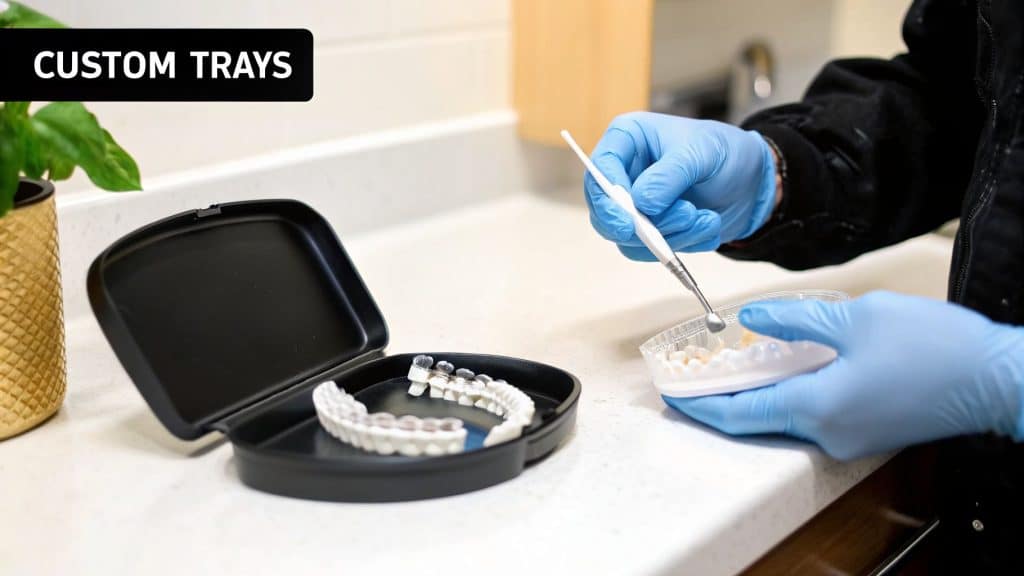
Unlike generic one-size-fits-all trays, these custom-moulded trays ensure the whitening gel makes even contact with every tooth surface while protecting your gums from irritation. The gradual process, typically spanning two to four weeks of daily use, allows for significant, controlled whitening with a lower risk of sensitivity compared to high-concentration in-office procedures.
Who Is It For?
This system is ideal for busy professionals who prefer to whiten their teeth on their own schedule, often overnight. It is also the standard recommendation for maintaining the results of a prior in-office whitening session. Many UK patients visiting Centre Dental Clinic for implant consultations will opt for take-home trays to brighten their natural teeth before their final restorations are placed, ensuring a seamless and brilliant smile. Popular systems include Opalescence PF and Philips Zoom NiteWhite, both offered as part of our comprehensive cosmetic packages.
What to Expect and Key Tips
After your dentist creates your custom trays, you will receive specific instructions on how much gel to use and how long to wear them, which can range from 30 minutes to several hours daily.
- Minimise Disruption: Wear your trays overnight while you sleep. This is convenient and can help reduce sensitivity as you produce less saliva.
- Application is Key: Apply a small, even bead of gel to the front-facing portion of each tooth impression in the tray. Overfilling can cause gum irritation.
- Avoid Stains: During the entire 2-4 week treatment period, diligently avoid staining foods and drinks like coffee, red wine, and curries.
- Manage Sensitivity: If your teeth become tender, use a sensitivity-focused toothpaste or ask your dentist for a desensitising gel to use in your trays.
- Proper Storage: Always store your trays in their protective case to prevent them from warping or getting lost.
- Follow-Up: Schedule a follow-up appointment with your dentist after two weeks to assess your progress and make any necessary adjustments to your whitening plan.
3. Over-the-Counter Whitening Strips
For those looking for an affordable and convenient at-home whitening solution, over-the-counter whitening strips are a widely popular choice. These thin, flexible plastic strips are coated with a low-concentration peroxide gel (typically 5-14%) that you apply directly to your teeth. Worn for around 20-30 minutes daily, a full course of treatment usually lasts between one and two weeks.
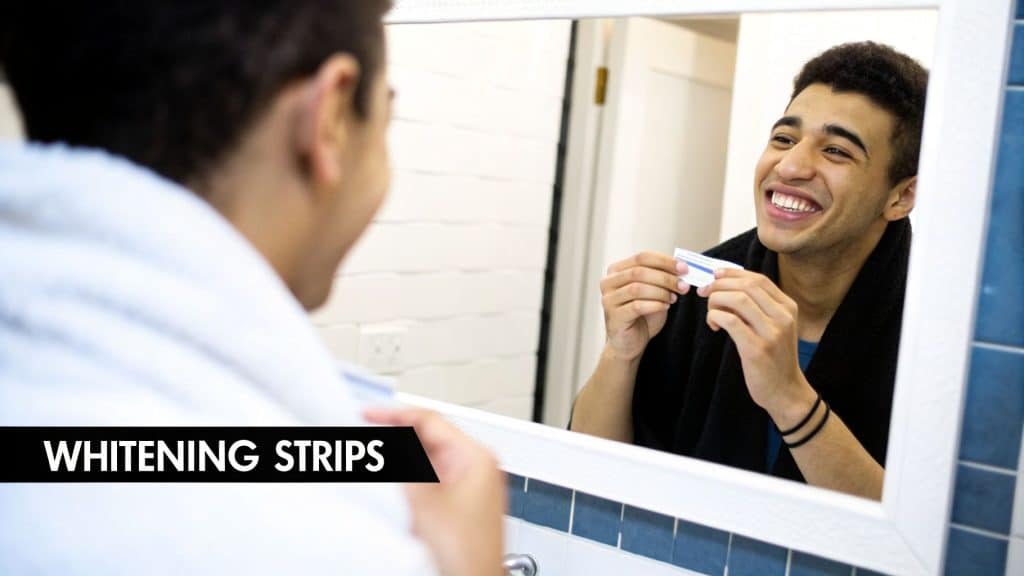
While they won’t deliver the dramatic transformation of a professional treatment, they are one of the best teeth whitening methods for gradually lifting light to moderate surface stains caused by daily food and drink consumption. Brands like Crest 3D Whitestrips, Oral-B, and Colgate have made this approach accessible to everyone, with options readily available in UK retailers like Boots and Superdrug.
Who Is It For?
Whitening strips are best suited for individuals with minor discolouration who want a subtle brightness boost without a significant financial investment. They are also an excellent maintenance tool. For example, patients who have undergone professional whitening at Centre Dental Clinic can use strips every few months to prolong the lifespan of their bright, white smile. They are a great starting point for anyone new to teeth whitening with minimal expectations.
What to Expect and Key Tips
For the best results, you must apply the strips consistently and correctly. Adhesion is key, so make sure your teeth are dry before application.
- Proper Application: Pat your teeth dry with a clean cloth before applying the strips to ensure they stick firmly and the gel makes even contact with the enamel.
- Follow Instructions: Never exceed the recommended wear time. Overuse is a common cause of significant tooth sensitivity and gum irritation.
- Manage Sensitivity: If you experience discomfort, try reducing the frequency of use to every other day or choose a product formulated for sensitive teeth.
- Aftercare: Refrain from eating or drinking for at least 30 minutes after removing the strips to allow the whitening agent to continue working.
- Enhance Effects: Using a whitening toothpaste between applications can help remove new surface stains and boost your overall results.
- Professional Perspective: Remember that strips are not a substitute for professional dental care. For a deeper understanding of how to whiten teeth effectively and safely, professional advice is always recommended.
4. Whitening Toothpaste and Mouthwash
For gradual, long-term maintenance and subtle stain removal, whitening toothpastes and mouthwashes are an essential part of any oral hygiene routine. Unlike professional treatments that deliver dramatic changes, these products work by using mild abrasives to gently polish away surface stains or by containing low concentrations of peroxide to lift discolouration over time. They are designed for daily use and are one of the best teeth whitening methods for maintaining the brilliance of a professionally brightened smile.
These daily care products are not intended for deep, intrinsic stain removal but are incredibly effective at preventing new stains from setting in. By consistently using them, you can prolong the results of more intensive whitening procedures and keep your smile looking fresh and clean every day.
Who Is It For?
This approach is perfect for individuals looking for a low-cost, low-commitment way to achieve subtle enhancement or maintain existing results. For example, UK dental tourists who have undergone professional whitening at Centre Dental Clinic find these products invaluable for preserving their investment after returning home. They are also ideal for patients with zirconium crowns or All-on-4 restorations, as they help keep the surrounding natural teeth matched to the shade of the cosmetic work. Young adults also benefit from this method as a preventive measure against future staining.
What to Expect and Key Tips
Whitening toothpastes and mouthwashes offer a gradual lightening effect over several weeks. Consistency is the most important factor for success.
- Product Selection: Choose products with a recognised seal of approval from a dental association, which confirms their safety and effectiveness. Popular brands include Colgate Optic White and Crest 3D White.
- Brushing Technique: Use a soft-bristled brush and gentle, circular motions. Aggressive brushing can wear down enamel and cause sensitivity, negating the whitening benefits.
- Consistency is Key: For optimal maintenance and stain prevention, use these products twice daily as part of your regular oral care routine.
- Manage Sensitivity: If you experience tooth sensitivity, switch to a formula specifically designed for it, such as Sensodyne Whitening, which offers both brightening and protective benefits.
- Combine Methods: For the best results, use whitening toothpaste as a maintenance tool after undergoing a professional in-clinic treatment to accelerate and preserve your bright new smile.
5. Whitening Mouthwashes and Rinses
Whitening mouthwashes and rinses offer a gentle, cumulative approach to brightening your smile. These products typically contain a low concentration of a peroxide-based whitening agent, such as 0.5-1% hydrogen peroxide, which works to lift mild surface stains over time. Used daily after brushing, they function primarily as a maintenance tool rather than a powerful primary treatment, making them one of the best teeth whitening methods for supporting long-term results.
Unlike more intensive treatments, these rinses gradually improve tooth colour while also providing the oral health benefits of a standard mouthwash, like freshening breath and reducing plaque. Their gentle action makes them a practical addition to a daily oral hygiene routine for subtle, ongoing stain prevention.
Who Is It For?
This method is perfect for individuals looking to maintain the results of a professional whitening treatment or prevent new stains from forming. It’s an excellent choice for busy professionals who need a simple, quick step to keep their smile bright. For patients at Centre Dental Clinic with dental implants or veneers, these rinses help keep the surrounding natural teeth a consistent shade without using abrasive methods. They are a supporting product, not a replacement for professional whitening.
What to Expect and Key Tips
Whitening rinses are integrated into your daily oral care routine, used after brushing your teeth. Consistency is key to seeing any noticeable effect on your smile’s brightness.
- Proper Use: For maximum effect, use the rinse immediately after brushing your teeth. Swish it thoroughly for the recommended time (usually 30-60 seconds) to ensure the solution makes full contact with all tooth surfaces.
- Consistency is Crucial: To achieve any visible benefit, you must use the mouthwash consistently, typically twice a day. The results are gradual and subtle.
- Combine for Better Results: For enhanced stain-fighting power, pair your whitening rinse with a whitening toothpaste. This combination can be more effective at tackling daily surface stains from coffee and tea.
- Maintenance, Not Transformation: Think of whitening rinses as a maintenance product. They will not deliver dramatic shade changes but are excellent for prolonging the effects of a professional treatment.
- Proper Storage: Keep the bottle in a cool, dark place to preserve the stability and effectiveness of the active whitening agents.
6. Natural and Traditional Whitening Methods (Charcoal, Powders & Oil Pulling)
Social media and wellness circles have popularised natural teeth whitening methods, with activated charcoal powders and the Ayurvedic practice of oil pulling leading the trend. These approaches appeal to those seeking non-clinical, budget-friendly alternatives to conventional treatments. Activated charcoal is an abrasive powder thought to lift surface stains by scrubbing the enamel, while oil pulling involves swishing an edible oil (like coconut oil) in the mouth to supposedly “pull” toxins and bacteria, which may contribute to a brighter appearance over time.
While these methods are celebrated for their perceived natural origins, their effectiveness as one of the best teeth whitening methods is debated, and scientific support for significant shade changes is limited. The primary action is typically surface stain removal rather than deep, intrinsic bleaching.
Who Is It For?
This category is mainly for individuals curious about holistic health practices or those looking for a very gentle, low-cost way to manage minor, fresh surface stains. Wellness enthusiasts in the UK and social media followers experimenting with DIY beauty routines are the primary audience. It is not suitable for people with deep-set discolouration, tetracycline stains, or those needing predictable, noticeable results for cosmetic work like crowns or veneers.
What to Expect and Key Tips
If you choose to experiment with these methods, caution is paramount to protect your oral health. Unlike professionally supervised treatments, these carry risks if used incorrectly.
- Consult Your Dentist: Always discuss these methods with a dental professional before trying them. They can assess your enamel health and advise on potential risks like abrasion or gum irritation.
- Limit Abrasive Use: If using charcoal or whitening powders, restrict use to a maximum of 1-2 times per week with a soft-bristled brush and minimal pressure to avoid enamel erosion.
- Oil Pulling Practice: Start with shorter swishing times, like 5 minutes, to prevent jaw fatigue. Do not swallow the oil; spit it into a waste bin to avoid clogging your drains.
- Monitor Your Gums: Watch for any signs of gum irritation or recession, and stop immediately if you notice any adverse effects.
- Combine with Hygiene: These methods are not a substitute for proper oral hygiene. Continue to brush twice daily with fluoride toothpaste and floss regularly for true oral health.
7. Whitening Bonding and Resin Application (Direct Restorations)
For teeth with intrinsic stains that traditional bleaching cannot resolve, direct bonding with a composite resin is an excellent solution. This minimally invasive cosmetic procedure involves a skilled dentist applying a tooth-coloured resin directly onto the tooth’s surface to mask deep-seated discolouration, such as that caused by tetracycline or fluorosis. It is a fantastic and fast way to achieve a uniform, bright smile.
Unlike veneers, which require tooth preparation, bonding is applied directly and sculpted by hand in a single visit. This makes it one of the best teeth whitening methods for those seeking immediate improvement without altering the natural tooth structure. The resin is carefully matched to the desired shade of your surrounding teeth, creating a seamless and natural-looking finish.
Who Is It For?
This method is perfect for individuals with stubborn stains that do not respond to chemical whitening. It is also an ideal budget-conscious alternative to porcelain veneers for correcting minor imperfections, chips, or gaps alongside discolouration. At Centre Dental Clinic, our cosmetic dentists frequently use whitening bonding as part of a complete smile makeover, sometimes in combination with All-on-4 restorations to ensure every tooth in the new smile has a consistent, brilliant colour.
What to Expect and Key Tips
The procedure is typically painless and can be completed in just one appointment. The dentist etches the tooth surface, applies a bonding agent, and then carefully sculpts the composite resin before hardening it with a special light.
- Shade Matching: Always request that the shade matching be done under both natural and clinic lighting for the most accurate and natural-looking result.
- Maintenance: Schedule a professional polishing every 6-12 months. This helps remove surface stains from the resin and restores its original lustre.
- Post-Treatment Care: For the first 24-48 hours, avoid staining foods and drinks like coffee, tea, and red wine to prevent the new bonding from absorbing pigments.
- Preventing Damage: Avoid biting on hard foods, ice, or using your teeth to open packages, as this can chip or fracture the resin material.
- Future Planning: Discuss your long-term goals with your dentist. While bonding is a superb solution, porcelain veneers may offer a more durable and stain-resistant option for the future.
8. Teeth Whitening with Veneer/Crown Shade Coordination (Smile Design Integration)
For a truly seamless and brilliant smile makeover, whitening is not just a standalone procedure but a crucial first step. This integrated approach involves whitening your natural teeth before crafting and placing cosmetic restorations like veneers or crowns. By doing this, your new porcelain work can be perfectly colour-matched to your brighter, rejuvenated natural teeth, ensuring a uniform and dazzling appearance across your entire smile.
This method is the cornerstone of comprehensive cosmetic dentistry, as restorations cannot be whitened once they are made. Whitening your natural teeth beforehand sets a new, brighter baseline for your entire smile design, making it one of the best teeth whitening methods for anyone planning a significant cosmetic upgrade.
Who Is It For?
This coordinated treatment is essential for individuals undergoing a smile makeover that combines natural teeth with cosmetic restorations. For instance, a patient might need four veneers on their upper front teeth but want the rest of their visible teeth to match. UK patients visiting Centre Dental Clinic for smile makeovers often use this strategy to achieve a cohesive, high-end result without needing veneers on every single tooth. It’s also ideal for those replacing old, dark crowns or getting All-on-4 implants, ensuring the new prosthetic teeth blend beautifully with any remaining natural teeth.
What to Expect and Key Tips
The process begins with a professional whitening treatment to achieve your desired shade. After this, your cosmetic dentist will proceed with creating and fitting your new restorations.
- Allow for Shade Stabilisation: Schedule your whitening at least two weeks before your final crown or veneer fitting. This allows the shade of your natural teeth to settle, ensuring an accurate and lasting colour match.
- Communicate Your Goals: Clearly discuss your desired final shade with your dentist. Use shade guides and provide before/after photos to set clear expectations for your smile design.
- Document the Progress: Take photographs in natural light at each stage to track the shade progression and aid in the final matching process.
- Discuss Longevity: Ask about the durability of the coordinated work and how to best maintain the colour of your natural teeth to match your restorations over time.
This integrated planning is fundamental to achieving a flawless aesthetic. Learn more about how dental veneers in Antalya, Turkey, can be combined with whitening for a complete and affordable smile transformation.
9. Internal Tooth Whitening (Endodontic Bleaching for Root Canal Teeth)
Sometimes, a single tooth becomes dark from the inside out, often after trauma or a root canal treatment. When this happens, external whitening methods are ineffective because the discolouration originates from within the tooth’s pulp chamber. Internal tooth whitening, also known as endodontic bleaching, is a specialised procedure designed to correct this deep, intrinsic staining and restore the tooth’s natural colour.
This technique involves an endodontist or cosmetic dentist placing a bleaching agent directly inside the tooth. A small opening is made at the back, the whitening gel is applied into the pulp chamber, and the tooth is sealed with a temporary filling. This process is repeated every few days until the desired shade is achieved, making it one of the best teeth whitening methods for non-vital (dead) teeth.
Who Is It For?
Internal bleaching is the ideal solution for individuals with a single dark tooth that has undergone root canal therapy and does not respond to traditional whitening. It is perfect for patients who want to create a uniform smile without resorting to a veneer or crown on an otherwise healthy tooth structure. At Centre Dental Clinic, we often use this technique as part of a larger smile design, ensuring that every single tooth, including those with a history of trauma, contributes to a bright, harmonious appearance.
What to Expect and Key Tips
The procedure is painless as the tooth has no nerve. Your dentist will first ensure the root canal filling is sealed off to protect it from the bleaching agent. The whitening agent then works from the inside over several days.
- Document the Progress: Always request before-and-after photographs to track the tooth’s shade change throughout the treatment.
- Realistic Timelines: Be prepared for multiple appointments. The process can take one to two weeks, with the gel being replaced every few days.
- Protect Your Restoration: While the temporary filling is in place, avoid chewing hard foods on that tooth and stay away from staining foods like coffee or red wine.
- Coordinate with Other Procedures: If you plan on getting a new crown on an adjacent tooth, complete the internal bleaching first. This allows your dentist to perfectly match the new restoration to your newly whitened tooth.
- Final Restoration: Once the ideal colour is achieved, a permanent, tooth-coloured filling will be placed to seal the back of the tooth.
10. Whitening as Part of a Comprehensive Smile Makeover (Full Aesthetic Restoration Package)
For those dreaming of a complete smile transformation, integrating teeth whitening into a full aesthetic restoration package is the ultimate solution. This approach goes beyond just brightening your teeth; it redesigns your entire smile by combining professional whitening with other cosmetic procedures like porcelain veneers, zirconium crowns, dental implants, and gum contouring. It’s a coordinated, multi-step process planned by a cosmetic dentist to achieve a flawless, harmonious, and natural-looking result.
This method is one of the best teeth whitening methods because it addresses the smile as a whole. Whitening is strategically timed as the foundational step, establishing a bright, youthful baseline colour for all subsequent restorative work. This ensures that new veneers or crowns are perfectly matched to your newly whitened natural teeth, creating a seamless and uniform appearance rather than a patchwork of different shades.
Who Is It For?
This all-encompassing approach is perfect for individuals seeking a dramatic and permanent improvement to their smile, often for life-changing events like a wedding or milestone birthday. It is also the preferred choice for those with complex dental needs, such as missing teeth, extensive staining, worn-down enamel, or misalignments that cannot be fixed with whitening alone. Many UK patients travel to Centre Dental Clinic in Antalya for these packages, which combine multiple treatments like All-on-4 implants with whitening and veneers into a single, cost-effective plan.
What to Expect and Key Tips
A full smile makeover begins with a detailed digital smile design and consultation. Your dentist will map out every stage of the treatment, ensuring each procedure is performed in the correct sequence for optimal results.
- Initial Consultation: Always request a free online consultation. Provide clear “before” photos and communicate your desired tooth shade and smile goals.
- Transparent Pricing: Ask for a detailed, all-inclusive price quote with no hidden costs. A reputable clinic will provide a written plan outlining the cost of whitening, restorations, warranties, and any other included services.
- Treatment Sequencing: Discuss the treatment timeline thoroughly. Whitening is usually done first, followed by a two-week stabilisation period before crowns or veneers are placed to ensure a perfect colour match.
- Logistical Planning: If pursuing dental tourism, plan your flights, accommodation, and follow-up care. Clinics like Centre Dental Clinic often assist with these arrangements to make the process smooth.
- Warranty and Revisions: Inquire about the warranty coverage for your restorations and the clinic’s policy on any necessary revisions.
To explore how whitening can be the first step in your total smile transformation, learn more about the advanced aesthetic dentistry options available in Antalya, Turkey, and see how a full package can deliver stunning results.
Top 10 Teeth Whitening Methods Comparison
| Method | Implementation Complexity 🔄 | Resource Requirements | Expected Outcomes ⭐📊 | Ideal Use Cases | Key Advantages ⚡💡 |
|---|---|---|---|---|---|
| Professional In-Office Teeth Whitening (Dental Clinic Treatment) | High — clinician‑performed, 60–90 min; strict protocol | High — 15–35% peroxide, LED/laser, gum barrier, clinic setup; £250–450 | Immediate, dramatic whitening (2–8 shades); peak 1 week; durable 6–12 months; ⭐⭐⭐⭐ 📊 High | Pre-veneer/smile design, events, stubborn extrinsic stains | Fast single‑visit results; professional monitoring; ⚡ rapid; 💡 request touch‑up trays |
| Custom Whitening Trays with Professional Gel (Take‑Home) | Moderate — impressions + lab trays; dentist supervision | Moderate — custom trays, 10–22% gel, follow‑up; £150–300 + refills | Gradual controlled whitening over 2–4 weeks; consistent maintenance; ⭐⭐⭐ 📊 Medium | Maintenance after in‑office whitening; flexible home use; busy schedules | Reusable, cost‑effective, lower sensitivity; ⚡ flexible timing; 💡 wear at night for comfort |
| Over‑the‑Counter Whitening Strips | Low — self‑applied daily 20–30 min | Low — 5–14% peroxide strips; no prescription; £15–40 | Subtle improvement (1–4 shades), uneven possible; results 1 week; ⭐⭐ 📊 Low–Medium | Budget users; light surface stains; travel convenience | Very affordable; easy access; ⚡ convenient; 💡 apply to dry teeth and follow timing |
| Whitening Toothpaste | Very low — daily use as part of brushing | Minimal — mild abrasives or low peroxide, fluoride; £3–12 | Very gradual (½–1 shade over months); maintenance role; ⭐ 📊 Low | Long‑term maintenance; preventive care; adjunct to professional whitening | Inexpensive, integrates into routine; low sensitivity risk; 💡 choose ADA‑approved formulas |
| Whitening Mouthwashes and Rinses | Very low — rinse 20–30 sec twice daily | Minimal — 0.5–1% peroxide rinse; £4–10 | Extremely slow/minimal visible whitening; supportive benefits; ⭐ 📊 Very Low | Adjunct maintenance; freshening breath; patients seeking easy routine | Easy to use, adds oral health benefits; low risk; 💡 use after brushing for best contact |
| Natural & Traditional Methods (Charcoal, Powders, Oil Pulling) | Low effort but unregulated; technique‑dependent | Low — charcoal/powders/oils; £3–25 | Unproven/variable results; risk of enamel abrasion or irritation; ⭐/⚠️ 📊 Minimal/Unreliable | Experimentation by wellness users; those preferring “natural” approaches (with caution) | Inexpensive and trendy but inconsistent; ⚠️ potential harm; 💡 consult dentist before use |
| Whitening Bonding and Resin Application (Direct Restorations) | Moderate — chairside composite work; one appointment | Moderate — composite resin, color matching; £150–300 per tooth | Immediate masking of intrinsic stains; natural appearance; ⭐⭐⭐⭐ 📊 High (per tooth) | Tetracycline/fluorosis cases, isolated intrinsic stains, budget cosmetic fixes | Rapid, minimally invasive alternative to veneers; reversible; 💡 expect periodic polishing/replacement |
| Veneer/Crown Shade Coordination (Smile Design Integration) | High — sequenced planning and lab work | High — whitening + lab veneers/crowns, multiple visits; variable cost | Cohesive, high‑quality long‑term aesthetic results; ⭐⭐⭐⭐⭐ 📊 Very High | Comprehensive smile makeovers, implant restorations, cosmetic harmony | Ensures matched restorations and natural teeth; professional coordination; 💡 allow 2–3 weeks between whitening and placement |
| Internal Tooth Whitening (Endodontic Bleaching) | Specialized — endodontic technique, multiple visits | Specialized — internal peroxide, temporary restorations; £300–500 | Effective for dark root‑canal teeth; gradual over 1–2 weeks; ⭐⭐⭐ 📊 Medium–High (single tooth) | Darkened root canal teeth, trauma cases needing internal treatment | Targets intrinsic discoloration without full crown replacement initially; 💡 may require crown later |
| Whitening as Part of Comprehensive Smile Makeover (Full Aesthetic Package) | Very high — multi‑disciplinary sequencing and planning | Very high — whitening, veneers/crowns/implants, digital planning; £3,000+ (package) | Transformational, coordinated long‑term results across smile; ⭐⭐⭐⭐⭐ 📊 Very High | Patients seeking full aesthetic transformation or dental tourism packages | All‑inclusive coordination, color harmony, warranty/aftercare; ⚡ high impact; 💡 request detailed written plan and timeline |
Your Personalised Path to a Whiter Smile Starts Here
Navigating the world of teeth whitening can feel overwhelming, with a vast array of options promising a dazzling, celebrity-worthy smile. As we have explored, the journey from professional in-clinic laser treatments to at-home whitening strips and even cosmetic solutions like veneers is not a one-size-fits-all process. The best teeth whitening methods are not universal; they are the ones that are best for you, your specific type of staining, your budget, and your lifestyle.
The key takeaway is that achieving your ideal shade is an entirely personal and achievable goal. You now have a clear understanding of the distinct differences between these approaches. For instance, while whitening toothpastes offer a convenient and affordable way to lift recent surface stains from your daily coffee, they cannot alter the intrinsic colour of your teeth. In contrast, professional in-office whitening provides the most dramatic and rapid results for deep-set discolouration, but it comes at a higher price point.
From Information to Action: Designing Your Smile
The power of this knowledge lies in your ability to make an informed decision. You can now weigh the pros and cons with confidence.
- For quick, noticeable results for an upcoming event: Professional in-office whitening remains the gold standard.
- For a flexible, professional-grade solution at home: Custom-fitted trays from a dentist offer a perfect balance of effectiveness and convenience.
- For tackling a single dark tooth after a root canal: Internal bleaching is a highly specific and effective solution that no whitening strip can address.
- For a complete and permanent smile transformation: Integrating whitening with a broader cosmetic plan involving veneers or crowns allows for total control over your final aesthetic.
It is crucial to move beyond the marketing claims and look at the science. Methods like activated charcoal may be popular, but their abrasive nature can pose a risk to your enamel with no proven long-term whitening benefit. Your enamel is precious, and protecting it should always be a priority. This is why a professional consultation is so valuable; it’s not just about whitening, it’s about whitening safely.
A Brighter Smile is a Healthier Smile Remember, the pursuit of a whiter smile often goes hand-in-hand with improved oral hygiene. The very act of considering whitening encourages us to pay closer attention to what we eat and drink, how we brush, and the overall health of our mouth. This renewed focus is a benefit in itself, leading to healthier gums and stronger teeth long after the whitening gel is gone.
Ultimately, your smile is a fundamental part of your identity and confidence. Investing in it is an investment in yourself. Whether you start with small, consistent habits or opt for a comprehensive smile makeover, the path you choose should align with your personal goals and deliver results that make you proud to smile. The information in this guide is your first step; the next is to take action. You are now equipped to have a productive conversation with a dental professional, moving from “what are my options?” to “which option is right for me?” This shift in perspective is what turns a desire for a brighter smile into a tangible, personalised plan.
Ready to take the next step towards a radiant smile with expert guidance? At Center Dental Clinic, we specialise in creating personalised treatment plans, combining the best teeth whitening methods with world-class cosmetic dentistry to achieve your dream results. Book your free, no-obligation consultation today at Center Dental Clinic and discover how our affordable, high-quality care in Turkey can give you a smile you’ll love to share.